
Article Critique: The Good and the Bad of Napoleon III
The article The Good and the Bad of Napoleon III discusses the merits and demerits of France’s ruler, Napoleon III, and his foreign policy. The author depicts the Italian unification plan as one of Napoleon III’s successes in foreign policy. However, the subsequent choices regarding intervention in Mexico and Prussia were his disadvantages, leading to the downfall of his reign. France agreed to go to war in support of Italy against Austria to gain Italy’s freedom. The battle victory made Napoleon III famous, built France’s reputation, and weakened Austria’s power in Europe. However, the gains from the battle were short-term. France developed rival tensions with other European powers. Napoleon III overlooked the nation’s potential and decided to expand European territory into the American region by making Austrian Archduke Maximilian the new Emperor of Mexico. This decision made the Mexican people resistant to the French, escalating the Civil War[1]. Napoleon III’s foreign policy was completely destroyed by his decision to go to war with Prussia in pursuit of finding the next Spanish king. The subsequent failed plan ruined Napoleon III’s leadership.
The article’s author adopts ideas from different sources, including magazines, articles, and books, which offer supportive thoughts to reinforce the ideas presented. The author has presented an argumentative thesis and addressed it thoroughly. The primary focus of the article, as depicted in the thesis, is to expound on the positive and negative outcomes of Napoleon III’s foreign policy plan. The author has extensively discussed how the policy influenced Napoleon III’s leadership. It is clear that the negative aspects of the leader’s decisions outweigh his merits in his leadership position. The author’s ideas align with his primary objectives, and no opposing thoughts are presented. The article opens up room for further study to understand how Napoleon III’s mistakes have influenced European territories and political decisions.
Bibliography
McMillan, James F. Napoleon III. New York: Routledge, 1991.
[1] James F. Mcmillan, Napoleon III (New York: Routledge, 1991).
ORDER A PLAGIARISM-FREE PAPER HERE
We’ll write everything from scratch
Question 
Article Critique: The Good and the Bad of Napoleon III
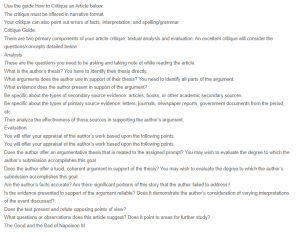
Use the guide How to Critique an Article below.
The critique must be offered in narrative format.
Your critique can also point out errors of facts, interpretation, and spelling/grammar.
The Good and the Bad of Napoleon III
Critique Guide:
There are two primary components of your article critique: textual analysis and evaluation. An excellent critique will consider the questions/concepts detailed below.
Analysis
These are the questions you need to be asking and taking note of while reading the article.
What is the author’s thesis? You have to identify their thesis directly.
What arguments does the author use in support of their thesis? You need to identify all parts of the argument.
What evidence does the author present in support of the argument?
Be specific about the types of secondary source evidence: articles, books, or other academic secondary sources.
Be specific about the types of primary source evidence: letters, journals, newspaper reports, government documents from the period, etc.
Then analyze the effectiveness of those sources in supporting the author’s argument.
Evaluation
You will offer your appraisal of the author’s work based upon the following points.
You will offer your appraisal of the author’s work based upon the following points.
Does the author offer an argumentative thesis that is related to the assigned prompt? You may wish to evaluate the degree to which the author’s submission accomplishes this goal.
Does the author offer a lucid, coherent argument in support of the thesis? You may wish to evaluate the degree to which the author’s submission accomplishes this goal.
Are the author’s facts accurate? Are there significant portions of this story that the author failed to address?
Is the evidence presented in support of the argument reliable? Does it demonstrate the author’s consideration of varying interpretations of the event discussed?
Does the text present and refute opposing points of view?
What questions or observations does this article suggest? Does it point to areas for further study?
The Good and the Bad of Napoleon III
In the mid-nineteenth century, Europe as a whole was going through many political changes. Some of the newer powers were increasing in power while older powers were growing weaker in comparison. During this period, Napoleon III ruled over France from 1852 to 1870. Napoleon III was just like his uncle Napoleon Bonaparte since he also wanted to turn France into one of Europe’s dominant countries(1). His foreign policy was full of plans that would increase France’s power and influence; however, not all of them worked out. While Napoleon III gained recognition from his early successes in helping with Italian unification, his later choices, like the failed intervention in Mexico and his poor response to the Prussian situation, would lead to future consequences for France and be the catalyst for the empire’s downfall.
Napoleon III’s first idea for his foreign policy was to support Italy in gaining its freedom from Austria. During Napoleon III’s rule, Italy was divided, and the Kingdom of Sardinia turned to France for help in fighting against Austria. Napoleon would agree to join the war in 1859, bringing about nationalist excitement in France. Roger Price writes that when Napoleon left for Italy, it was met with “bellicose popular nationalism”(2). The turning point came after an Italian nationalist, Felice Orsini, tried to assassinate him. According to James McMillan, the attack pushed Napoleon to take a stronger anti-Austrian stance and act on behalf of the Italian cause(3).
Napoleon’s decision to back Italy was much more than a move based on emotions; it had a greater purpose. His goal was to weaken Austria, gain popularity, and territory for France. He would accomplish this goal when his army helped defeat Austria in the battles of Magenta and Solferino, which would lead to France regaining the territory of Savoy and Nice. This would go on to boost Napoleon III’s image and make him look like a hero to Italian nationalists, and increase France’s influence in Europe(4). These victories helped solidify France’s reputation as a significant European power and increased Napoleon III’s popularity at home and in the eyes of others(5).
Napoleon III’s success with the Italian unification demonstrated his ability to act quickly and make good decisions. His involvement in Italy increased his fame and France’s influence in Europe. While this benefited France in the short term by gaining land and prestige, it also increased tensions with other European powers like Austria and Prussia, which would return to haunt France in the future(6). However, people still view these actions as one of his better ideas regarding his foreign policy.
After his success in Italy, Napoleon III gained confidence and had the “great idea” to try to expand Europe to the American region. His goal was to try to fix his relationship with Austria and put the Austrian Archduke Maximilian as the new Emperor in Mexico. This decision would become one of his biggest mistakes during his rule. In 1861, Mexico was in financial trouble and could not pay its debts to European countries. Napoleon III used this as a reason to send French troops to Mexico. His real plan, however, was to turn Mexico into an empire controlled by the French in the Americas region. This plan did not consider that America would quickly jump into action once the American Civil War ended (7).
Early on, the French army would find success in taking Mexico City. But this was only a short-lived victory. Since the Mexican people started to resist, the French would end up stuck in an expensive war to maintain their hold. The United States would then go on to end its Civil War, and make it known that the French were not welcome anymore. Then, in 1867, Maximilian would end up being captured and executed, and France would realize that it had only wasted time and resources for nothing(8).
The Mexican expedition was a total failure, gaining France nothing in the long run and be one of the key contributors that led to the downfall of the Second Empire. Napoleon III’s goal for Mexico was unrealistic and was more of a dream than reality(9). The war for Mexico would end up weakening France’s army too much for the future and be one of the significant contributors to the downfall of the Second Empire(10). This failure damaged Napoleon III’s credibility and showed that his foreign policy was no longer working as planned. The people of France would start to question Napoleon III’s ability to keep the country stable and make the right choices with his foreign policy(11).
While the Mexico policy was a failure, his war with Prussia in 1870 would end up being the most significant failure he made during his rule. The Prussian chancellor, Otto von Bismarck, wanted to unite the German states under Prussian rule. He planned to go to war with France and use them as a common enemy to unite the states. Napoleon III would play right into Bismarck’s hands(12). After a dispute over who would become the next Spanish king, France declared war on Prussia in July 1870. However, this would prove to be a mistake since France was the aggressor; they would have no help from other countries. France’s military had also been weakened by the war in Mexico a few years before and would not have the strength to fight with all their might. Meanwhile, Prussia had a strong, modern army and a well-organized government prepared for war.
The French army was poorly prepared for the war that they started. Prussia was much stronger and ready for the war that France started(13). The war would quickly end in disaster for France. Early in the war, Napoleon III would end up being captured after just two months of the war. His empire would then collapse, and the Third Republic was declared in France(14). This defeat disappointed the French people and led to the people putting their faith in Napoleon III’s leadership. His miscalculations in the war showed that he had lost touch with Europe’s military changes.
This defeat would cost Napoleon III much more than just a war. It would lead to the complete collapse of Napoleon III’s rule(15). French citizens would lose trust in him as the emperor, and his earlier accomplishments would be forgotten. He had misjudged the situation, trusted the wrong people, and underestimated his enemies(16). This loss also allowed Prussia to unify Germany under its leadership, forever changing the balance of power in Europe and weakening France’s role on the continent.
When looking at Napoleon III’s foreign policy, we see he had the same ambition as his uncle Napoleon I(17). His early success in Italy showed he could act effectively and increase France’s position in Europe. However, his failures with Mexico and Prussia would stand out much more than his successes. The decisions he made later in his rule showed that his overambitious mindset would lead him to make decisions with poor planning(18). These mistakes had lasting effects, not only for France but for Europe as a whole.
Notes
1. Works of Napoleon III. The Eclectic Magazine of Foreign Literature, Science, and Art 25, no. (February 1872), 778, University of Alabama Libraries Scout Catalog.
2. Roger, Price, Napoleon III and the Second Empire. (London: Routledge, 1997), 32 University of Alabama Libraries Scout Catalog.
3. James F. McMillan, Napoleon III. (London: Longman, 1991), 82-83, University of Alabama Libraries Scout Catalog.
4. Roger, Price, Napoleon III and the Second Empire. (London: Routledge, 1997), 32-33, University of Alabama Libraries Scout Catalog.
5. England and Napoleon III: The Truth on the Italian Question (London: Edward Stanford, 1860), 43, Nineteenth Century Collections Online, Gale.
6. James F. McMillan, Napoleon III. (London: Longman, 1991), 109-110, University of Alabama Libraries Scout Catalog.
7 James F. McMillan, Napoleon III. (London: Longman, 1991), 149-152, University of Alabama Libraries Scout Catalog.
8. James F. McMillan, Napoleon III. (London: Longman, 1991), 149-152, University of Alabama Libraries Scout Catalog.
9. James F. McMillan, Napoleon III. (London: Longman, 1991), 149, University of Alabama Libraries Scout Catalog.
10. James F. McMillan, Napoleon III. (London: Longman, 1991), 151, University of Alabama Libraries Scout Catalog.
11. James F. McMillan, Napoleon III. (London: Longman, 1991), 151, University of Alabama Libraries Scout Catalog.
12. James F. McMillan, Napoleon III. (London: Longman, 1991), 159-160, University of Alabama Libraries Scout Catalog.
13. James F. McMillan, Napoleon III. (London: Longman, 1991), 163, University of Alabama Libraries Scout Catalog.
14. Roger, Price, Napoleon III and the Second Empire. (London: Routledge, 1997), 62-63, University of Alabama Libraries Scout Catalog.
15. Roger, Price, Napoleon III and the Second Empire. (London: Routledge, 1997), 62 University of Alabama Libraries Scout Catalog.
16. James F. McMillan, Napoleon III. (London: Longman, 1991), 163, University of Alabama Libraries Scout Catalog.
17. Works of Napoleon III. The Eclectic Magazine of Foreign Literature, Science, and Art 25, no. (February 1872), 778, University of Alabama Libraries Scout Catalog.
18. Roger, Price, Napoleon III and the Second Empire. (London: Routledge, 1997), 59 University of Alabama Libraries Scout Catalog.