
Applying Research Skills-Limited Access to Healthcare
Limited access to healthcare is a problem of concern that should be addressed promptly. This problem is associated with a high morbidity rate, poor prognosis, and low quality of life for patients (Salami et al., 2020). Various factors cause limited access to healthcare. Firstly, treatment costs impede access to healthcare (Ayón et al., 2020; Fante-Coleman & Jackson-Best, 2020). The uninsured population is affected worst by high treatment costs, hence limited access to healthcare services. Secondly, transportation barriers impact access to healthcare. The lack of an appropriate public transport system may affect access to healthcare by persons in rural areas (Fante-Coleman & Jackson-Best, 2020).
Furthermore, individuals with physical impairment may experience challenges accessing healthcare services. Thirdly, social determinants of health impact access to healthcare. This entails factors such as access to quality education and the neighborhood. For example, findings indicate that infant mortalities are about twice as high in African Americans compared to Caucasians (USC.edu, n.d.).
The problem of limited access to healthcare is relevant to my practice. As a clinician, I embrace justice when providing patient-centered care. I don’t’ discriminate against specific patients. As such, I am a key stakeholder in ensuring more patients access quality healthcare services. During my practice, I witnessed an incidence of limited access to healthcare. A patient with chronic renal injury reported that she could not afford treatment due to financial constraints. We involved the healthcare facility’s’ administration, which resolved to help the patient get insured. Get in touch with us at eminencepapers.com. Our homework help will save you tons of time and energy required for your assignment papers.
Academic Peer-Reviewed Journal Articles
I used two online databases, Google Scholar and PubMed, to locate peer-reviewed articles. These databases allowed me to customize searches to articles published between 2019 and 2020. This enabled me to access the most current information. I used keywords such as “”health care access”” and “”rural nursing”” to locate my articles.
Assessing Credibility and Relevance of Information Sources
To evaluate the credibility of sources, I used two main criteria. Firstly, I selected peer-reviewed articles from internationally recognized journals. I assessed the articles for timelessness, accuracy, relevance, and authority. I chose articles published within the last five years. The credentials of the authors and their affiliated institutions are reputable. Further, the information found in the sources is generalizable and relevant to the topic.
Annotated Bibliography
Ayón, C., Ramos Santiago, J., & López Torres, A. S. (2020). Latinx Undocumented Older Adults, Health Needs, and Access to Healthcare. Journal of Immigrant and Minority Health, 22(5), 996–1009. https://doi.org/10.1007/s10903-019-00966-7
The authors aimed to examine the perceptions of undocumented immigrants about their health and access to healthcare. Structured questionnaires were used to collect data from the respondents. Findings indicated that undocumented immigrants have limited healthcare coverage. They are expected to adopt an out-of-pocket payment method for their healthcare services. Treatment costs per visit for these immigrants are approximately $100 to $300. As such, they have inadequately controlled chronic health conditions. According to the authors, policies that aim to increase undocumented immigrants’ access to healthcare should be formulated. This article is relevant because it identifies a vulnerable population with limited access to health. Furthermore, it evaluates the impact of limited access to health and proposes a strategy for addressing the problem.
Fante-Coleman, T., & Jackson-Best, F. (2020). Barriers and Facilitators to Accessing Mental Healthcare in Canada for Black Youth: A Scoping Review. Adolescent Research Review, 5(2), 115–136. https://doi.org/10.1007/s40894-020-00133-2
The article aims at identifying the barriers and enablers for access to mental health care by black youths in Canada. The authors conducted a literature review of articles published between 2005 and 2019. They sought their sources from online databases such as CINAHL and PubMed. Findings indicate that barriers to access to mental health care can be classified into three groups. Systemic factors include limited access to healthcare practitioners, geographical barriers, and high treatment costs. Secondly, practitioner-associated factors include racism, discrimination, little organizational support, and lack of culturally competent services. Thirdly, personal and communal factors include stigma. According to the authors, the enablers for accessing mental health services include healthy relationships and adequate family support. This article is relevant because it identifies black youths as a population with limited access to mental healthcare. Additionally, the article identifies the etiologies for the limited access to healthcare and proposes potential solutions.
Mason, D., Ingham, B., Urbanowicz, A., Michael, C., Birtles, H., Woodbury-Smith, M., Brown, T., James, I., Scarlett, C., Nicolaidis, C., & Parr, J. R. (2019). A Systematic Review of What Barriers and Facilitators Prevent and Enable Physical Healthcare Services Access for Autistic Adults. Journal of Autism and Developmental Disorders, 49(8), 3387–3400. https://doi.org/10.1007/s10803-019-04049-2
This article identifies factors that facilitate and impede access to healthcare services by autistic children. According to the authors, the potential barriers to healthcare access include inappropriate communication between patients and healthcare providers, absence of sensory sensitivities, and inadequate planning. The other barriers include stigma, geographical barriers, and limited understanding of autism by healthcare providers. According to the authors, healthcare providers should be trained and equipped with adequate knowledge about autism, including appropriate communication techniques and sensory sensitivities to improve the patient experience. The article is relevant because it evaluates factors that impede access to healthcare by the autistic population and proposes strategies for addressing these barriers.
Salami, B., Mason, A., Salma, J., Yohani, S., Amin, M., Okeke-Ihejirika, P., & Ladha, T. (2020). Access to healthcare for immigrant children in Canada. International Journal of Environmental Research and Public Health, 17(9). https://doi.org/10.3390/ijerph17093320
This article aims to investigate access to healthcare by immigrants living in Canada. The authors conducted a descriptive qualitative study. Data collection was accomplished via interviews. Findings indicate that the significant healthcare access barriers include language, cultural differences, poor relationships between patients and healthcare providers, and financial constraints. According to the authors, a concerted effort among various stakeholders can be used to address these barriers. Firstly, policies that increase healthcare access for immigrants should be formulated. Secondly, healthcare facilities should cultivate cultural unity and inclusivity in the workplace. The article is relevant because it evaluates factors that impede immigrants’ access to healthcare and proposes strategies for addressing these barriers.
Learnings from the Research
The research process equipped me with relevant knowledge about the limited access to healthcare. Firstly, I learned that immigrants have limited access to healthcare services. Secondly, I realized that the causes of limited access to healthcare include limited access to healthcare practitioners, geographical barriers, high treatment costs, racism, discrimination, little organizational support, and lack of culturally competent services. To address this problem, all stakeholders should cooperate to develop policies that improve healthcare access. Furthermore, I learned how to evaluate the credibility of journal articles.
References
Ayón, C., Ramos Santiago, J., & López Torres, A. S. (2020). Latinx Undocumented Older Adults, Health Needs and Access to Healthcare. Journal of Immigrant and Minority Health, 22(5), 996–1009. https://doi.org/10.1007/s10903-019-00966-7
Fante-Coleman, T., & Jackson-Best, F. (2020). Barriers and Facilitators to Accessing Mental Healthcare in Canada for Black Youth: A Scoping Review. Adolescent Research Review, 5(2), 115–136. https://doi.org/10.1007/s40894-020-00133-2
Mason, D., Ingham, B., Urbanowicz, A., Michael, C., Birtles, H., Woodbury-Smith, M., Brown, T., James, I., Scarlett, C., Nicolaidis, C., & Parr, J. R. (2019). A Systematic Review of What Barriers and Facilitators Prevent and Enable Physical Healthcare Services Access for Autistic Adults. Journal of Autism and Developmental Disorders, 49(8), 3387–3400. https://doi.org/10.1007/s10803-019-04049-2
Salami, B., Mason, A., Salma, J., Yohani, S., Amin, M., Okeke-Ihejirika, P., & Ladha, T. (2020). Access to healthcare for immigrant children in Canada. International Journal of Environmental Research and Public Health, 17(9). https://doi.org/10.3390/ijerph17093320
USC.edu. (n.d.). How to Improve Access to Health Care: Current Issues and Potential Solutions. https://healthadministrationdegree.usc.edu/blog/how-to-improve-access-to-health-care/
ORDER A PLAGIARISM-FREE PAPER HERE
We’ll write everything from scratch
Question 
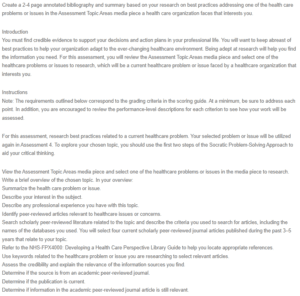
Create a 2-4 page annotated bibliography and summary based on your research on best practices addressing one of the health care problems or issues in the Assessment Topic Areas media piece a health care organization faces that interests you.
Applying Research Skills-Limited Access to Healthcare
Introduction
You must find credible evidence to support your decisions and action plans in your professional life. You will want to keep abreast of best practices to help your organization adapt to the ever-changing healthcare environment. Being adept at research will help you find the information you need. For this assessment, you will review the Assessment Topic Areas media piece and select one of the healthcare problems or issues to research, which will be a current healthcare problem or issue faced by a healthcare organization that interests you.
Instructions
Note: The requirements outlined below correspond to the grading criteria in the scoring guide. At a minimum, be sure to address each point. In addition, you are encouraged to review the performance-level descriptions for each criterion to see how your work will be assessed.
For this assessment, research best practices related to a current healthcare problem. Your selected problem or issue will be utilized again in Assessment 4. To explore your chosen topic, you should use the first two steps of the Socratic Problem-Solving Approach to aid your critical thinking.
View the Assessment Topic Areas media piece and select one of the healthcare problems or issues in the media piece to research. Write a brief overview of the chosen topic. In your overview:
Summarize the health care problem or issue.
Describe your interest in the subject.
Describe any professional experience you have with this topic.
Identify peer-reviewed articles relevant to healthcare issues or concerns.
Search scholarly peer-reviewed literature related to the topic and describe the criteria you used to search for articles, including the names of the databases you used. You will select four current scholarly peer-reviewed journal articles published during the past 3–5 years that relate to your topic.
Refer to the NHS-FPX4000: Developing a Health Care Perspective Library Guide to help you locate appropriate references.
Use keywords related to the healthcare problem or issue you are researching to select relevant articles.
Assess the credibility and explain the relevance of the information sources you find.
Determine if the source is from an academic peer-reviewed journal.
Determine if the publication is current.
Determine if information in the academic peer-reviewed journal article is still relevant.
Analyze academic peer-reviewed journal articles using the annotated bibliography organizational format. Provide a rationale for the inclusion of each selected article. The purpose of an annotated bibliography is to document a list of references along with crucial information about each one. The detail about the reference is the annotation. Developing this annotated bibliography will create a foundation of knowledge about the selected topic. In your annotated bibliography:
Identify the purpose of the article.
Summarize the information.
Provide a rationale for the inclusion of each article.
Include the conclusions and findings of the article.
Write your annotated bibliography in paragraph form. The annotated bibliography should be approximately 150 words (1–3 paragraphs).
List the complete reference for the source in APA format (author, date, title, publisher, et cetera) and use APA format for the annotated bibliography.
Make sure the references are listed in alphabetical order, are double-spaced, and use hanging indents.
Summarize what you have learned from developing an annotated bibliography.
Summarize what you learned from your research in a separate paragraph or two at the end of the paper.
List the main points you learned from your research.
Summarize the main contributions of your chosen sources and how they enhanced your knowledge about the topic.