
Analysis of Theory Worksheet
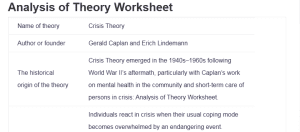
| Name of theory | Crisis Theory |
| Author or founder | Gerald Caplan and Erich Lindemann |
| The historical origin of the theory | Crisis Theory emerged in the 1940s–1960s following World War II’s aftermath, particularly with Caplan’s work on mental health in the community and short-term care of persons in crisis: Analysis of Theory Worksheet. |
| Basic assumptions | Individuals react in crisis when their usual coping mode becomes overwhelmed by an endangering event.
Unless some intervention ensues shortly, imbalances can produce breakdown or maladaptive behavior. |
| Underlying assumptions | Everyone is prone to crisis; timely and systematic intervention can create balance.
An individual’s response to a situation depends on perception, support, and pre-existing coping ability. |
| Key concepts | Dangerous event, vulnerable situation, precipitating factor, active state of crisis, reintegration or resolution of crisis, coping skills, support networks. |
| Foci/unit of analysis | The individual within the context of their immediate surroundings and crisis. |
| Philosophical or conceptual framework | Founded on humanistic and systems theory, it emphasizes person-in-environment and time-limited, goal-focused intervention. |
| Strengths of theory | It offers a logical method of short-term intervention, is useful during emergencies or short-term psychosocial stress, and can be used in many settings, from residential care, medical care, schools, and community service. |
| Limitations of Theory | It is not meant to treat long-standing or long-term issues
It will not necessarily address systemic causes or complex trauma other than by integrating other theories. |
| Common criticisms | Moderation toward short-term goals may not effectively address the current deeper cores of trauma or societal inequality unless added theories are used. |
| When and with whom it would be appropriate to use the theory/model | Appropriate for individuals with acute trauma or stress, such as sudden disruptions of life like those experienced by children like Ella. |
| Consistency of theory/model with social work principles | Theory is very consistent, including a focus on empowerment, person-in-environment, timely intervention, and restoration of functioning. |
| Identification of goodness of fit with ethical principles | It aligns with social work ethics of dignity, self-determination, and the right to safety and intervention during distress. |
| Ways in which theory/model informs research methods | Informs research on intervention, crisis response evaluations, and short-term therapy outcomes.
Provides a framework for studying individual recovery and system response. |
| Implications for social work practice | It promotes crisis intervention, risk assessment, and stabilization.
It encourages time-sensitive and culture-competent care and is best suited for young individuals in residential treatment, such as Ella. |
ORDER A PLAGIARISM-FREE PAPER HERE
We’ll write everything from scratch
Question 
Pls Note:
- Use the same case study < Ella Schultz > used in order#60527. Thank You.
*It is common for social workers to be presented with a crisis situation brought forth by clients, families, communities, and/or organizations. The ultimate goal is to restore the client to equilibrium. The five stages of the crisis are (1) the hazardous event, (2) the vulnerable stage, (3) the precipitating factor, (4) the state of active crisis, and (5) the reintegration or crisis resolution phase.
There are times when a social worker will use more than one theory to assist in conceptualizing the problem and intervention, particularly if the theories complement each other. For example, resiliency theory can be used alongside crisis theory.
Textbook:
- Turner’s Social Work Treatment 7th edition
- Chapter 16, “Historical Trauma Theory” (pp. H149–H162)
- Chapter 21, “Social Work Theory for Crisis, Disaster & Trauma” (pp. H204–H215)
Analysis of Theory Worksheet
To Prepare
- Review the same case study you selected in Week 2.
- Use the Analysis of a Theory Worksheet to help you dissect the theory. Use this tool to dissect the theory, employ the information in the table to complete your Assignment, and then keep it to add to your Theories Study Guide in Week 11.
QUESTION:
Submit a 1- to 2-page case write-up that addresses the following:
- *Map the client’s crisis using the five stages of the crisis.
- *Describe the client’s assets and resources (in order to understand the client’s resilience).
- *Describe how you, the social worker, will intervene to assist the client to reach the reintegration stage of the crisis. Be sure that the intervention promotes resiliency.
- *Explain how using crisis theory and resiliency theory together help in working with a client.
- *Submit also, as a separate document, your Week 5 Analysis of a Theory Worksheet.
Be sure to:
- Identify and correctly reference the case study you have chosen.
- Use literature to support your claims.
- Use APA formatting and style.
- Remember to double-space your paper.