
Alcohol Use Disorder Treatment
The case presented is of a 53-year-old Puerto Rican female with alcohol and gambling addiction comorbidity. She has been struggling with alcohol since her 20s. She reports that since the opening of a new casino near her home and being hooked to the casino by a friend two years ago, she has been struggling to maintain sobriety. She mentions that when gambling, she gets “high” and takes a few drinks to calm her during high-stakes games. She adds that this often results in her giving in to reckless drinking and gambling. She also mentions that she has been smoking over the past two years. Her present concern is that she had borrowed $50,000 off her retirement account to settle debts, which her husband is unaware of. These findings are suggestive of impulsivity toward alcohol use and gambling. A mental status examination of the patient revealed that she is alert and oriented to events and time. She is appropriately dressed for the occasion and weather and demonstrates goal-oriented, coherent, and clear speech. She avoids eye contact and demonstrates appropriate mannerisms, gestures, and tics. She self-reports a sad mood and denies hallucinations and paranoia. Though her impulse control is impaired, her insight and judgment are intact. She denies experiencing suicidal ideation and, or tendencies.
Decision Point One: Vivitrol 380mg IM in the Gluteal Area Every 4 Weeks
The patient presents with alcohol dependence. Vivitrol (Naltrexone) is an opioid antagonist. It is used in the management of opioid dependence and alcohol use disorders. It was selected because it maintains effectiveness in altering the reinforcing effects of alcohol that induce euphoria and cause impulsivity toward consuming it (Sharma et al., 2020). Depot injection of Naltrexone 380mg provides more favorable outcomes as they eliminate the need for daily pills that may be troublesome to persons with alcohol dependence. The patient, in this case, may benefit from IM Naltrexone.
Antabuse (disulfiram) and Campral (acamprosate) have also been used in managing alcohol use disorders. Disulfiram was not considered in this case because of its poor toxicological profile. Also, it has been linked with severe adverse events such as metallic taste, fatigue, headache, and even death. Lanz et al. (2023) report that disulfiram is not a safe option for all alcoholics and should only be used when other options are unavailable. Further, acamprosate was not considered, in this case, because of its high pill burden that may discourage compliance. This medication is taken in three divided doses and may not be favorable to patients with alcohol dependence under home-based care. Additionally, acamprosate use has been linked with side effects such as suicidal ideation and anxiety that may be particularly troublesome for patients with alcohol dependence as it may drive them to even more alcohol consumption (Donoghue et al., 2022). Therefore, this medication may thus not be favorable for this patient.
The aim of using Vivitrol was to eliminate alcohol dependence on the patient. Vivitrol is an opioid antagonist that alters the reinforcing effects of alcohol on inducing euphoria. It also modifies the hypothalamic-pituitary-adrenal axis, causing profound suppression of alcohol consumption (Sharma et al., 2020). It is for this reason that this option was selected.
An ethical consideration that may impact the treatment plan and communication with this patient is confidentiality. One of the patient’s concerns is the 50,000 dollars she had plucked from her retirement that her husband is unaware of, despite her husband being important in her treatment process.
Decision Point Two: Disulfiram 250mg Tab Orally Daily
Disulfiram is an FDA-approved medication used in treating alcohol dependence. It maintains effectiveness in discouraging alcohol use in patients motivated to quit alcohol (Sarkar et al., 2022). It acts by creating an unpleasant physiological effect that will demotivate alcoholics to consume alcohol. The patient, in this case, can benefit from disulfiram due to her motivation to quit alcohol.
The effectiveness of disulfiram in discouraging alcohol use prompted its inclusion in this case. The other available options were intramuscular Vivitrol and acamprosate. Vivitrol use in this patient may be discouraged due to its cost implications, the risk of injection site injury, and other risks associated with its use, such as hepatitis. Vivitrol, like other opioids, also presents the risk for opioid withdrawal upon concluding its use. Acamprosate is another medication option for treating chronic alcohol use and dependence. However, its use is not favored in this case due to pharmacokinetic considerations. This medication is taken in divided doses and may present compliance challenges in persons struggling with alcohol addiction.
This intervention was aimed at eliminating alcohol dependence in the patient. Disulfiram discourages alcohol consumption by eliciting unpleasant physiologic responses upon alcohol use. These responses are a consequence of alcohol dehydrogenase inhibition and include palpitations, diaphoresis, hypotension, and tachycardia (Burnette et al., 2022). These responses will discourage a motivated person from quitting alcohol use.
An ethical concern that may impact the management process is beneficence and non-maleficence. The patient presented with alcohol dependence. Disulfiram use in alcohol dependence has been associated with severe adverse effects and even death. Healthcare providers thus have to weigh the benefits versus risks of using this medication on their patients. This medication should only be used under close supervision by caregivers as an ethical obligation to prevent harm and promote the well-being of the patient.
Decision Point Three: Acamprosate 666mg PO Three Times Daily
Acamprosate is an FDA-approved medication for treating chronic alcohol use and alcohol dependence. It is taken in divided doses and is effective in reducing alcohol withdrawal-associated distress. This medication has a tolerable safety profile and is not impacted by alcohol use (Donoghue et al., 2022). It can thus be used in both motivated and non-motivated patients for the management of alcohol dependence.
Other options available and effective in managing alcohol dependence are disulfiram and Vivitrol. Disulfiram maintains effectiveness in treating alcohol dependence. However, its use is not favored in this case due to its poor toxicological profile. Disulfiram has been associated with severe adverse events and even death. Disulfiram may also not be favorable in patients actively taking alcohol and is not advisable to be used within 12 hours of consuming alcohol. Due to its poor toxicological profile, close monitoring may be required (Sarkar et al., 2022). This option is, therefore, only applicable where other agents fail. Vivitrol is also effective in addressing alcohol dependence. However, intramuscular Vivitrol may not be considered due to the risk of injection site injury. Vivitrol is also relatively costly compared to oral alternatives.
This intervention was aimed at alleviating alcohol dependence. Acamprosate administered in three divided doses promotes a balance of inhibitory and excitatory neurotransmitters, thereby reducing withdrawal-associated distress. It is highly tolerable and can be used even in patients still taking alcohol (Donoghue et al., 2022). It can thus be used on this patient.
An ethical concern with the use of acamprosate is autonomy and the right to self-determination. Due to its dosing considerations and the possibility of non-compliance due to the high pill burden with acamprosate use, it is prudent that the patient be educated on the medication and other available options. In this respect, they should be educated on the perceived benefits of acamprosate and how it compares with other medications in this category.
Conclusion
The case presented concerns a patient with gambling addiction and alcohol abuse disorder. The patient also smokes. The priority intervention, in this case, is to address alcohol abuse disorder. Naltrexone is an FDA-approved medication for the management of alcohol abuse disorders. This drug maintains effectiveness in suppressing alcohol consumption. For this reason, Vivitrol was selected as the therapeutic option. As evident in the case, Vivirol use has been associated with side effects such as anxiety. These manifestations are often transient and may not require pharmacotherapy interventions. Disulfiram and acamprosate are other FDA-approved medications that are effective in managing alcohol dependence. While addressing alcohol dependence is key in this patient, other presenting issues, such as gambling addiction and smoking, also require addressing. It is paramount that the patient be educated on smoking cessation options to help her address smoking, which is increasingly becoming a concern to her. It is also important that the patient be referred to a counselor to address her gambling addiction.
References
Burnette, E. M., Nieto, S. J., Grodin, E. N., Meredith, L. R., Hurley, B., Miotto, K., Gillis, A. J., & Ray, L. A. (2022). Novel agents for the pharmacological treatment of alcohol use disorder. Drugs, 82(3), 251–274. https://doi.org/10.1007/s40265-021-01670-3
Donoghue, K., Hermann, L., Brobbin, E., & Drummond, C. (2022). The rates and measurement of adherence to Acamprosate in randomized controlled clinical trials: A systematic review. PLOS ONE, 17(2). https://doi.org/10.1371/journal.pone.0263350
Lanz, J., Biniaz-Harris, N., Kuvaldina, M., Jain, S., Lewis, K., & Fallon, B. A. (2023). Disulfiram: Mechanisms, applications, and challenges. Antibiotics, 12(3), 524. https://doi.org/10.3390/antibiotics12030524
Sarkar, S., Bhatia, G., Adagadda, S. S., & Chadda, R. K. (2022). Disulfiram safety in Alcohol Use Disorders: Experience from an addiction treatment center in India. Indian Journal of Psychiatry, 64(2), 216. https://doi.org/10.4103/indianjpsychiatry.indianjpsychiatry_386_21
Sharma, A., Kumar, A., Bansal, P. D., Bahetra, M., Gill, H. K., & Kumar, R. (2020). A comparative study on the safety and efficacy of naltrexone versus Baclofen versus Acamprosate in the management of alcohol dependence. Indian Journal of Psychiatry, 62(6), 650. https://doi.org/10.4103/psychiatry.indianjpsychiatry_201_19
ORDER A PLAGIARISM-FREE PAPER HERE
We’ll write everything from scratch
Question 
Alcohol Use Disorder Treatment
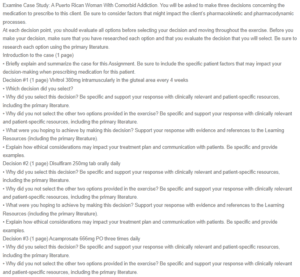
Examine Case Study: A Puerto Rican Woman With Comorbid Addiction. You will be asked to make three decisions concerning the medication to prescribe to this client. Be sure to consider factors that might impact the client’s pharmacokinetic and pharmacodynamic processes.
At each decision point, you should evaluate all options before selecting your decision and moving throughout the exercise. Before you make your decision, make sure that you have researched each option and that you evaluate the decision that you will select. Be sure to research each option using the primary literature.
Introduction to the case (1 page)
• Briefly explain and summarize the case for this Assignment. Be sure to include the specific patient factors that may impact your decision-making when prescribing medication for this patient.
Decision #1 (1 page) Vivitrol 380mg intramuscularly in the gluteal area every 4 weeks
• Which decision did you select?
• Why did you select this decision? Be specific and support your response with clinically relevant and patient-specific resources, including the primary literature.
• Why did you not select the other two options provided in the exercise? Be specific and support your response with clinically relevant and patient-specific resources, including the primary literature.
• What were you hoping to achieve by making this decision? Support your response with evidence and references to the Learning Resources (including the primary literature).
• Explain how ethical considerations may impact your treatment plan and communication with patients. Be specific and provide examples.
Decision #2 (1 page) Disulfiram 250mg tab orally daily
• Why did you select this decision? Be specific and support your response with clinically relevant and patient-specific resources, including the primary literature.
• Why did you not select the other two options provided in the exercise? Be specific and support your response with clinically relevant and patient-specific resources, including the primary literature.
• What were you hoping to achieve by making this decision? Support your response with evidence and references to the Learning Resources (including the primary literature).
• Explain how ethical considerations may impact your treatment plan and communication with patients. Be specific and provide examples.
Decision #3 (1 page) Acamprosate 666mg PO three times daily
• Why did you select this decision? Be specific and support your response with clinically relevant and patient-specific resources, including the primary literature.
• Why did you not select the other two options provided in the exercise? Be specific and support your response with clinically relevant and patient-specific resources, including the primary literature.
• What were you hoping to achieve by making this decision? Support your response with evidence and references to the Learning Resources (including the primary literature).
• Explain how ethical considerations may impact your treatment plan and communication with patients. Be specific and provide examples.
Conclusion (1 page)
• Summarize your recommendations on the treatment options you selected for this patient. Be sure to justify your recommendations and support your response with clinically relevant and patient-specific resources, including the primary literature.