
5E Lesson Plan – Relationship Between Division and Multiplication
| Teacher Candidate:
Grade Level: Date:
Unit/Subject:
Instructional Plan Title: |
Jones
4th 2/07/2021
Mathematics
Relationship between division and multiplication |
||
I. Planning |
|||
| Lesson Summary:
This lesson is supposed to enlighten the students on the effects of multiplication and division of numbers. In addition, it will help each understand the connection between the two. |
|||
| Classroom and student factors:
The 4th grade class has 30 students, 16 females and 14 males. Most of the students speak English as a native language. Two Hispanics and two Whites are learners of the English language. Five students are disabled learners, emotionally or otherwise. There are more white students than other races in the classroom. Six students’ mathematical capabilities are below the 4th grade. |
|||
| Standard(s):
Number and Operations in Base Ten |
Lesson Objective:
· Students should understand the inverse relationship between division and multiplication. |
||
| Anticipation of Common Misconceptions/Challenges:
· Communication in English · Active participation · Collaboration among students |
|||
| Key Vocabulary:
1. Multiplied 2. Groups of 3. Divide |
Differentiation:
· Use of visual aids · Use of images (place cards) |
||
| Probing Questions:
1. What effect does multiplication have on numbers? 2. What does ‘12*2’ mean? 3. What does division do to numbers? |
|||
| Materials:
· Flipcharts · Marker pens · Chalks · Rod · Place cards · Computer · Multiplication tables |
|||
II. Instruction |
|
| The 5Es | |
| ENGAGE (Anticipatory Set)
The teacher opens the lesson by activating prior knowledge, linking previous learning, and presenting objective and focus questions. (5 minutes) |
|
| · Use images to remind the class of past lesson’s basics
· Allow students to explain their ideas on the past lesson · Encourage students to talk about the day’s topic openly |
|
| EXPLORE (Multiple Means of Engagement)
Students collaborate in problem-solving in order to gain a conceptual understanding of the concept. The teacher asks probing questions and provides prompts to groups and individuals as they work to help them move toward mastery of the objective. (20 minutes) |
|
| · Pair work
· Group learning |
|
| EXPLAIN (Multiple Means of Representation)
Students explain/share findings from the EXPLORE activity, and the teacher facilitates class discussion. The teacher models and asks questions using student input to help connect student responses with the big idea of the lesson. Vocabulary and big-idea concepts are formally introduced. (20 minutes) |
|
| Discussion
Multiplication and division of both even and odd numbers Multiplication and division of single and double-digit numbers |
Direct Instruction
· Math games · Storytelling · Group/pair work |
| ELABORATE (Extension)
Practice/Application of the big idea to the same or new concept. (10 minutes) |
|
| · Use images to explain concepts
· Use PowerPoint presentations to engage all students equally and highlight basic concepts |
|
| EVALUATE (Multiple Means of Expression)
Formative assessment activity that is aligned to the objective and focus question to close the lesson. (5 minutes) |
|
| · Encourage students to explain their understanding of concepts
· Ask questions to test understanding · Use group tests to evaluate comprehension |
|
III. RATIONALE |
|
| RATIONALE
This lesson will utilize group or pair work, math games, and storytelling as methods of instruction. These have been chosen due to their ability to engage students mentally and increase their concentration in class. Group or pair work promotes critical thinking by motivating students to assist each other in solving a mathematical problem. The knowledge that others have is shared, leading to an enhanced understanding of the topic. The pairing of students will be done to ensure that those who speak the same mother tongue work together. This strategy allows the student to explain concepts to each other using their first language, which they easily comprehend. Math games are important in ensuring that all students remain motivated and alert in the classroom. The incorporation of fun activities in the classroom plays an important role in resolving the concentration challenge. It also simplifies the mathematical concepts and changes the learners’ attitudes toward the subject. Besides adding more fun to learning, games promote understanding of computations, mathematical thinking, and comprehension of various operations (WeAreTeachers, 2021). Storytelling is a practical form of instruction that turns numbers into interesting narrations (Schreiner, 2017). The teacher uses stories to test the students’ understanding, promote critical thinking, and maintain alertness. It also allows the incorporation of daily activities into the lesson, making math more applicable to the student’s life (Mathseeds, 2018). |
|
References
Mathseeds. (2018). 7 Effective Strategies for Teaching Elementary Math.
Schreiner, E. (2017). Effective Strategies in Teaching Elementary Mathematics.
WeAreTeachers. (2021). 14 Essential Strategies in Teaching Math.
ORDER A PLAGIARISM-FREE PAPER HERE
We’ll write everything from scratch
Question 
5E Lesson Plan
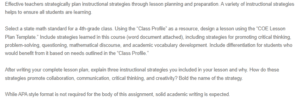
Effective teachers strategically plan instructional strategies through lesson planning and preparation. A variety of instructional strategies helps to ensure all students are learning.
Select a state math standard for a 4th-grade class. Using the “Class Profile” as a resource, design a lesson using the “COE Lesson Plan Template.” Include strategies learned in this course (word document attached), including strategies for promoting critical thinking, problem-solving, questioning, mathematical discourse, and academic vocabulary development. Include differentiation for students who would benefit from it based on needs outlined in the “Class Profile.”
After writing your complete lesson plan, explain three instructional strategies you included in your lesson and why. How do these strategies promote collaboration, communication, critical thinking, and creativity? Bold the name of the strategy.
While APA style format is not required for the body of this assignment, solid academic writing is expected.