
18th Century Arts
| Artist/Composer | Title of Work | Date Created | What makes it a work of this era? | |
| Rococo Artwork |
Jean-Honore Fragonard |
The Swing
|
1767 |
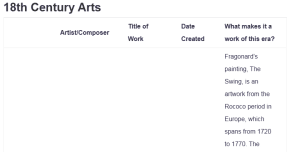
Fragonard’s painting, The Swing, is an artwork from the Rococo period in Europe, which spans from 1720 to 1770. The artist’s portrait captures a leisure activity enjoyed by the elites of the eighteenth century. Most French elites engaged in swinging as an outdoor recreational activity around the time the artwork was created. The background of the painting features a similar leisure site from that era.
The attire of the woman on the swing indicates that she comes from an affluent background. Her hat reveals that French elites played a significant role in society, resembling carefree shepherds. Fragonard illustrated the freedoms and restrictions faced by French nobles by incorporating natural and man-made elements in his artwork. Additionally, The Swing serves as a symbol of moral decay in aristocratic culture, as the woman lifts one leg and exposes her lower body, where unacceptable behavior was common during that time (Bruckbauer, 2025): 18th Century Arts. |
| Baroque Artwork |
Gian Lorenzo Bernini |
St. Peter’s Baldacchino |
1633
|
Bernini’s Baldacchino is a canopy built above St. Peter’s Basilica’s High Altar in Rome. The artwork was constructed during the Baroque era. Pope Urban VIII identified Bernini as the best Baroque-style artist to create it. The Baroque period is marked between 1600 and 1750. Bernini began the construction in 1624 and completed it in 1633.
He incorporated different Baroque elements, especially in alignment with the Pope’s family. Bernini used bronze as a symbol of cloth. There are coats of arms on the outer side of Baldacchino’s marble pedestals, illustrating a woman in childbirth. There are also Barberini bees on the coats of arms, demonstrating the elite background of the Pope. The art also features St. Peter’s Keys, symbolizing core values that foster Christians ‘ faith. Additionally, there are angel statues supporting the columns, showing Christians ‘ responsibility in redeeming the earth (Headout, 2025). |
Baroque Composition |
George Frideric Handel |
Messiah |
1741 |
Handel is a known Baroque-era superstar. He became an outstanding composer for writing English oratorios, which are non-staged sacred operas. Messiah is Handel’s famous oratorio, which depicts the life of Christ. Handel extracted the content of the music directly from the Bible, specifically the King James Version.
The artist composed the oratorio to present it in Dublin, Ireland, at a music concert. Handel made an impromptu decision to select singers and instrumentalists to help him in the performance. Among the singers was a well-known actress, which prompted critics to question her legitimacy in performing sacred content due to her acting role. It was also ironic for scriptural content to be performed in a concert rather than in a place of worship (McGlothlin & Bill, 2024). The critics enhanced the popularity of the music during the era. They depicted the different perspectives individuals hold regarding sacred content, focusing on when, where, and who should be involved in its performance. |
References
Bruckbauer, A. (2025). Smarthistory – Jean-Honoré Fragonard, The Swing. https://smarthistory.org/jean-honore-fragonard-the-swing/
Headout. (2025). Baldacchino of St. Peter | History, construction, & more. https://www.st-peters-basilica-tickets.com/st-peters-baldacchino/
McGlothlin, A., & Bill, J. (2024, November 22). Chapter 11: Music of George Frideric Handel (1685-1759). Pressbooks. https://rotel.pressbooks.pub/artofmusic/chapter/__unknown__-5/
ORDER A PLAGIARISM-FREE PAPER HERE
We’ll write everything from scratch
Question 
- After reading the module readings and examining the module resources, complete the18th Century and the Arts chart. To do this:
- a.Open the18th Century and the Arts [PDFX]or the18th Century and the Arts [DOCX] chart (ATTACHED), save as LastName_FirstName_M2-Assignment
- b. Use this chart to explore and explain selected works of art and music compositions from the 18th century.
- Using your UA credentials, access the ARTstor online database, available from the University of Alabama Library’s electronic databases collection.
- a. Select two (2) works of art, one from the Rococo period and another from the Baroque period.
- b. You may choose any works of art you wish. Be sure the works originate in Europe and are from the Rococo or the Baroque period.
- a. In the 18th Century and the Arts chart provided for you, identify:
- The artist or creator
- The title
- The year of creation
- An explanation of how each work belongs to the particular period. Use the textbook’s description of the two periods (Culture and Society in the Enlightenment) to specifically explain identifying characteristics.
18th Century Arts
- a. In the 18th Century and the Arts chart provided for you, identify:
- Next, using your UA credentials, access the Classical Music Library online database available from the University of Alabama Library’s electronic databases collection.
- a. Select and listen to a composition written in the Baroque style by one of the following composers: Johann Sebastian Bach, George Frederick Handel, Franz Joseph Haydn, and Wolfgang Amadeus Mozart.
- b. Listen to the full work.
- c. In the 18th Century and the Arts chart provided for you, identify:
- The composer
- The title
- The year of creation
- An explanation of what specific elements of this piece of music characterize it as music from the Baroque period.
Textbook:
- Name of book is:Western Civilization.
- Chapter is 17